
From Nothing to Everything: My Journey as an Artist
At one time I never thought that I would end up becoming an artist. Among my first paintings were those done at home in Jeddah, Saudi Arabia, in the bedroom of my sister, since it was there that we stored the art materials. I recall copying two Mediterranean landscapes which I had come across in an art book. At that time, I knew very little about painting. Really all I ever felt was a fascination with the idea that something I saw could go through my own way of perceiving it and then reappear on a canvas. Looking back now, I believe that a certain thing must have started back then even though I didn't have the words to express it.
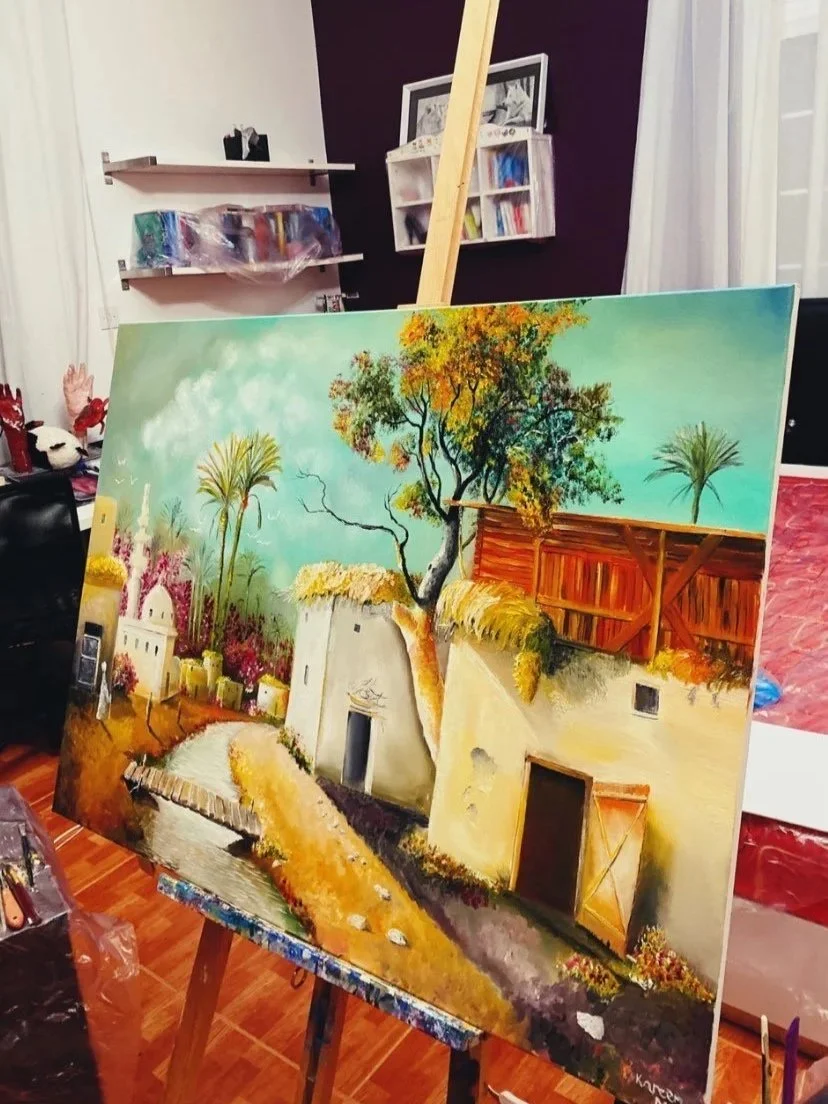
One of my earliest paintings, from when I was first discovering my love for painting
My interest in the history of painting grew stronger and stronger. I studied the works of Leonardo da Vinci, Raphael and Michelangelo, art pioneers of the Italian Renaissance and later those of Claude Monet and Henri Rousseau, and Paul Cézanne. I wished not only to understand how these artists painted but also to find out why certain images are able to move us so deeply. What is it that distinguishes an image which we merely see from one which stays with us? Why can a landscape, a particular combination of colors, or even the tiniest detail suddenly makes us more aware of being alive? Painting soon became my means of trying to answer these questions. For my thesis I used a phrase from Richard Powers which expressed something fundamental about this process: "First there was nothing. Then there was everything." Each painting starts with an empty surface and a world is gradually brought into being through attention, intuition, mistakes, memory and time.
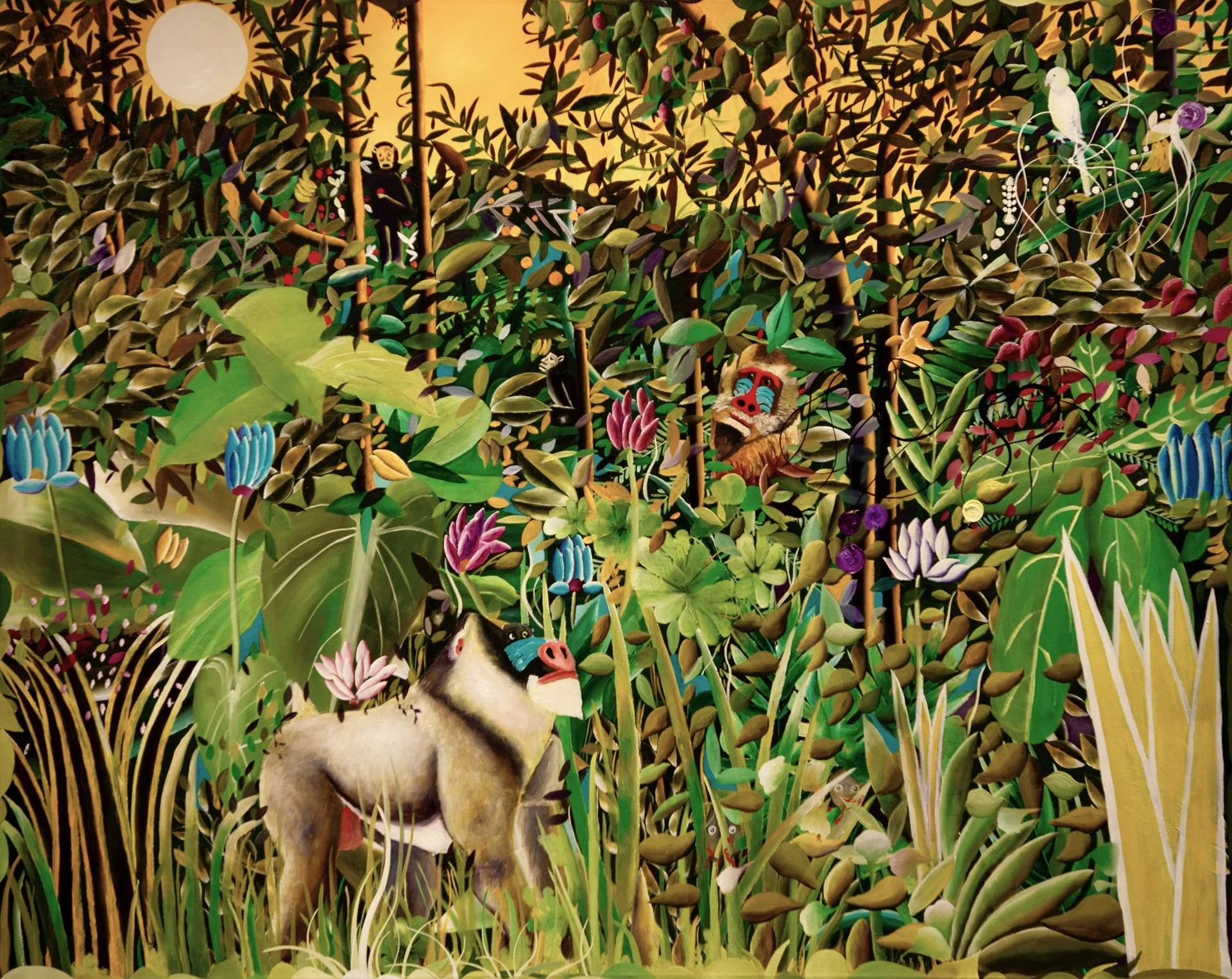
Kareem Moumina, The Mandril, Oil on canvas, New York, 2021
Of all the paintings I did when I was young, The Mandril is the one that is most important to me. I produced it when I was a university student, spending about a month on it from my dorm room. To keep the room ventilated I left both the door and the windows open, and on occasions students who were passing by would come and stand at the doorway to watch me work. We discussed the painting as it was still taking shape. At that time, I had no way of knowing just how significant it would turn out to be. Nowadays it is one of the very few paintings that I know I will never sell. To me, it contains the memory of a moment when painting ceased to be something I enjoyed and started to become part of who I was.
Henri Rousseau was the first artist to have a deep and significant influence on me. I was struck by his representations of jungles: their thick foliage, strange beauty, bright greens and that almost dreamy kind of stillness. He taught me that nature did not have to be shown exactly as it really is but could somehow be rebuilt using imagination. His paintings occupied a space between what had been observed and what had been invented, and this kind of freedom appealed to me. In The Mandril I started to explore that same idea. The vegetation became thick and plentiful, and the color green began to stand for something that went beyond its physical aspect. I linked it with growth, vitality and the mysterious life force which I felt was present in nature. What started out as an exercise based on another artist has now become the basis for the questions which still lie at the heart of my work today—beauty, consciousness, nature and what it means to experience the world fully.
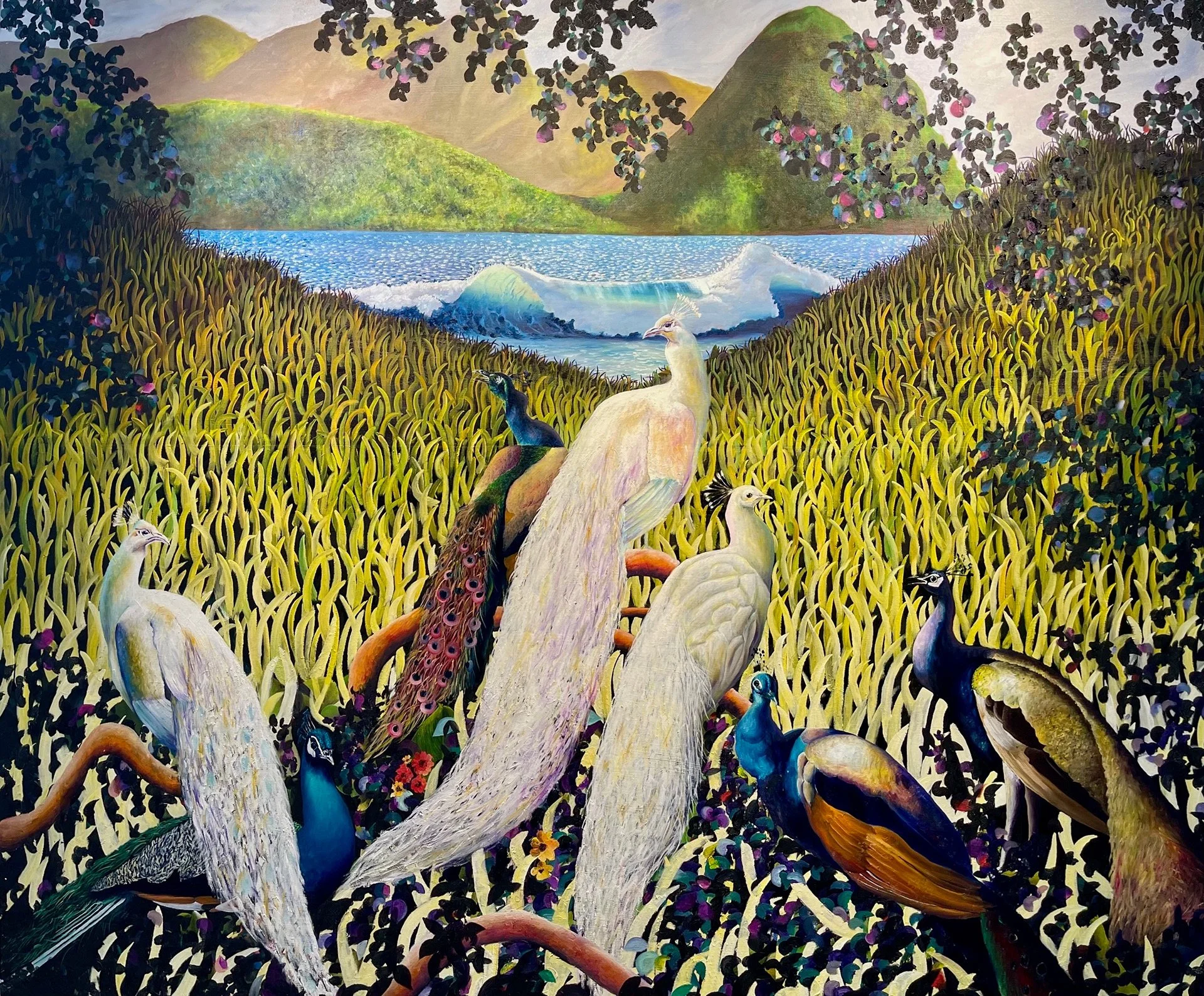
Kareem Moumina, Summer Birds, Oil on canvas, Washington D.C, 2021
As my artistic practice progressed, birds started to turn up again and again, together with flowers, water, forests, hands and ever more frequently imagined landscapes. I investigated the naturalism and sense of spatial depth found in paintings from the Dutch Golden Age, especially noting the remarkable way in which they treated birds and the natural world. Monet showed me something else: his paintings proved that color could convey not just what something appears to be, but the feeling one gets when encountering it. Gradually, I became less concerned with reproducing reality exactly and more interested in conveying the emotion inherent in reality. Although nature stayed identifiable in my paintings, it soon took on the role of a means of expressing memory, imagination and feeling.
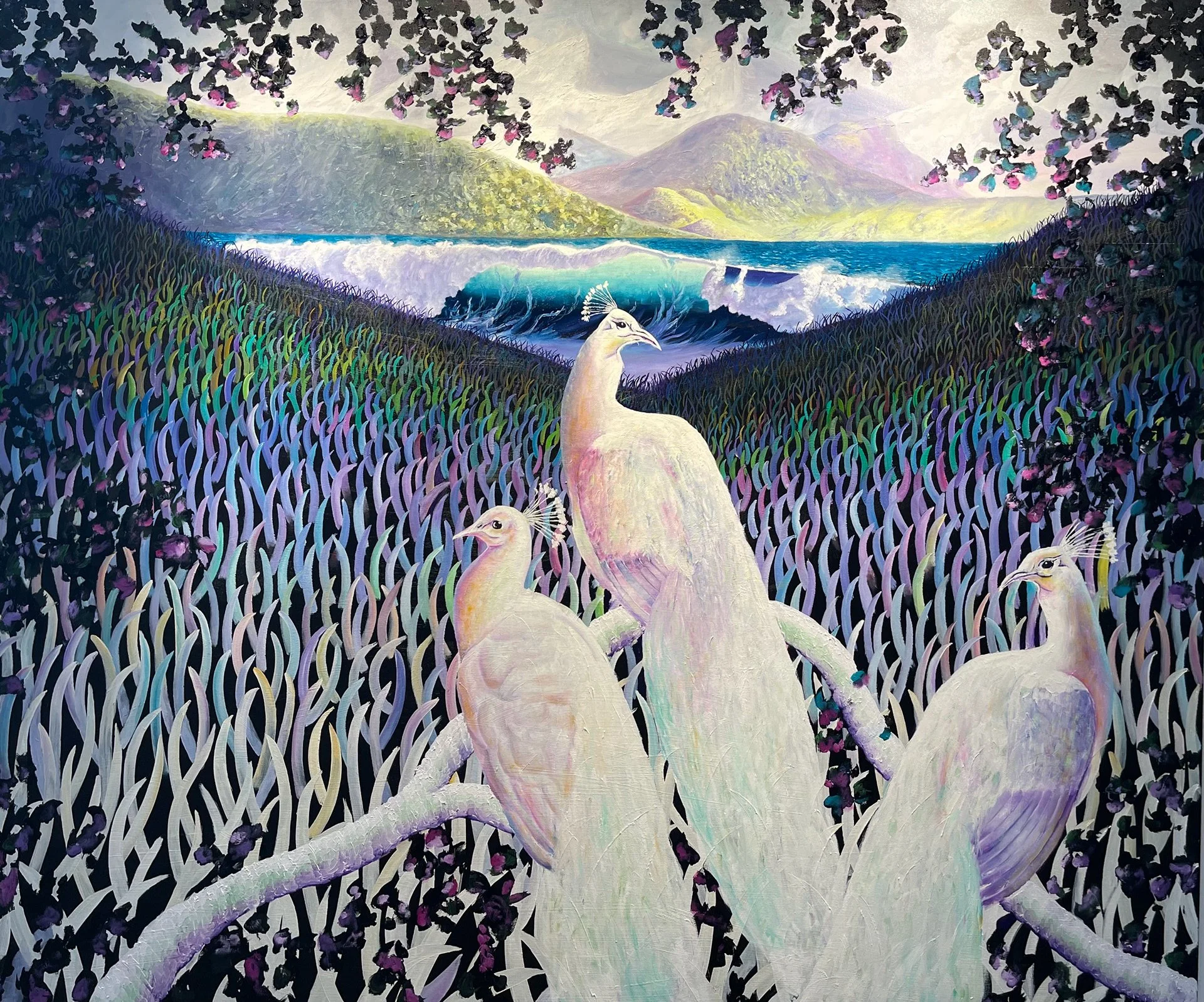
Kareem Moumina, Winter Birds, Oil on canvas, Washington D.C, 2022
This development also became a part of my personal experience. Since I was brought up in the Middle East, in the Philippines and in the United States, I had within myself a variety of landscapes, cultural practices, memories and visual traditions. For a long time, I saw these different experiences almost as if they belonged to separate worlds. Painting provided me with a space in which they did not have to stay distinct. Instead, they could overlap. The canvas then became an internal landscape in which fragments of experience could come together and produce something new. As I stated in my thesis, the contrast between these various cultural experiences had led to the creation of an internal 'canvas' from which I could draw ideas, memories and forms and then combine them into a harmonious whole.
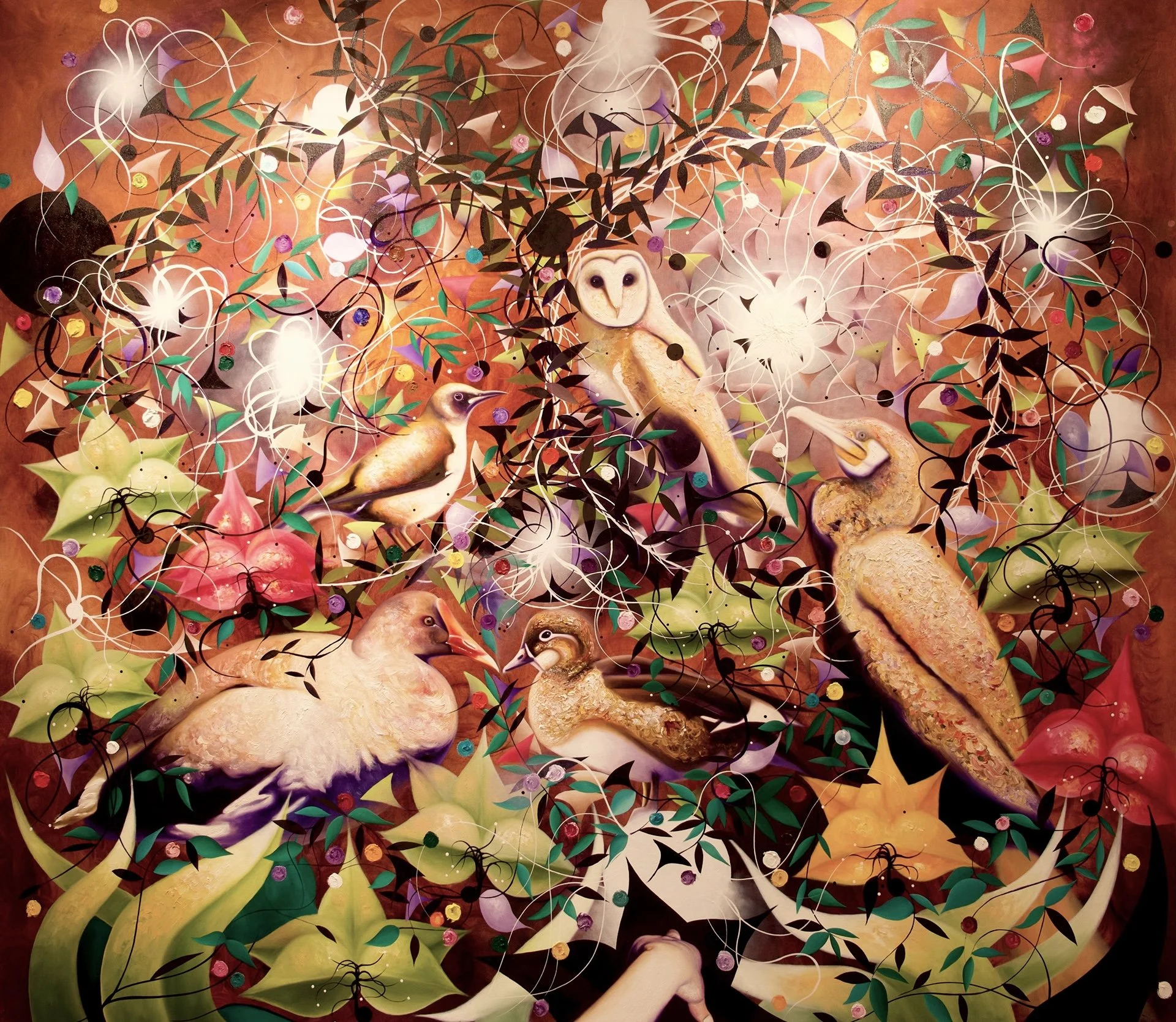
Kareem Moumina, The Harmony of Birds, Oil on canvas, New York, 2024
This ultimately brought me to a question which is now at the heart of my work: why is beauty important? Beauty is often regarded as merely decorative, as if a beautiful piece of work cannot at the same time have intellectual or emotional depth. My experience of painting has led me to the contrary view. Beauty requires our attention, and it is precisely this attention that can change the way we see the world. If we truly halt in front of a bird, a flower, someone else's face or a work of art and let ourselves look, something ordinary can at once become extraordinary. I have learned from art that seeing does not always mean noticing.
I have now realized that painting should not be seen primarily as the creation of beautiful things but rather as a way of paying attention. While I am painting, time appears to change. Images, memories, observations and emotions start to blend together so that I can no longer tell clearly where one ends and the other begins. In this process nature has stayed the same thing. It is there that I always go back to in order to find form, color, mystery and truth. Although my paintings may show imaginary worlds, their origin is still based on my experience of the natural world.
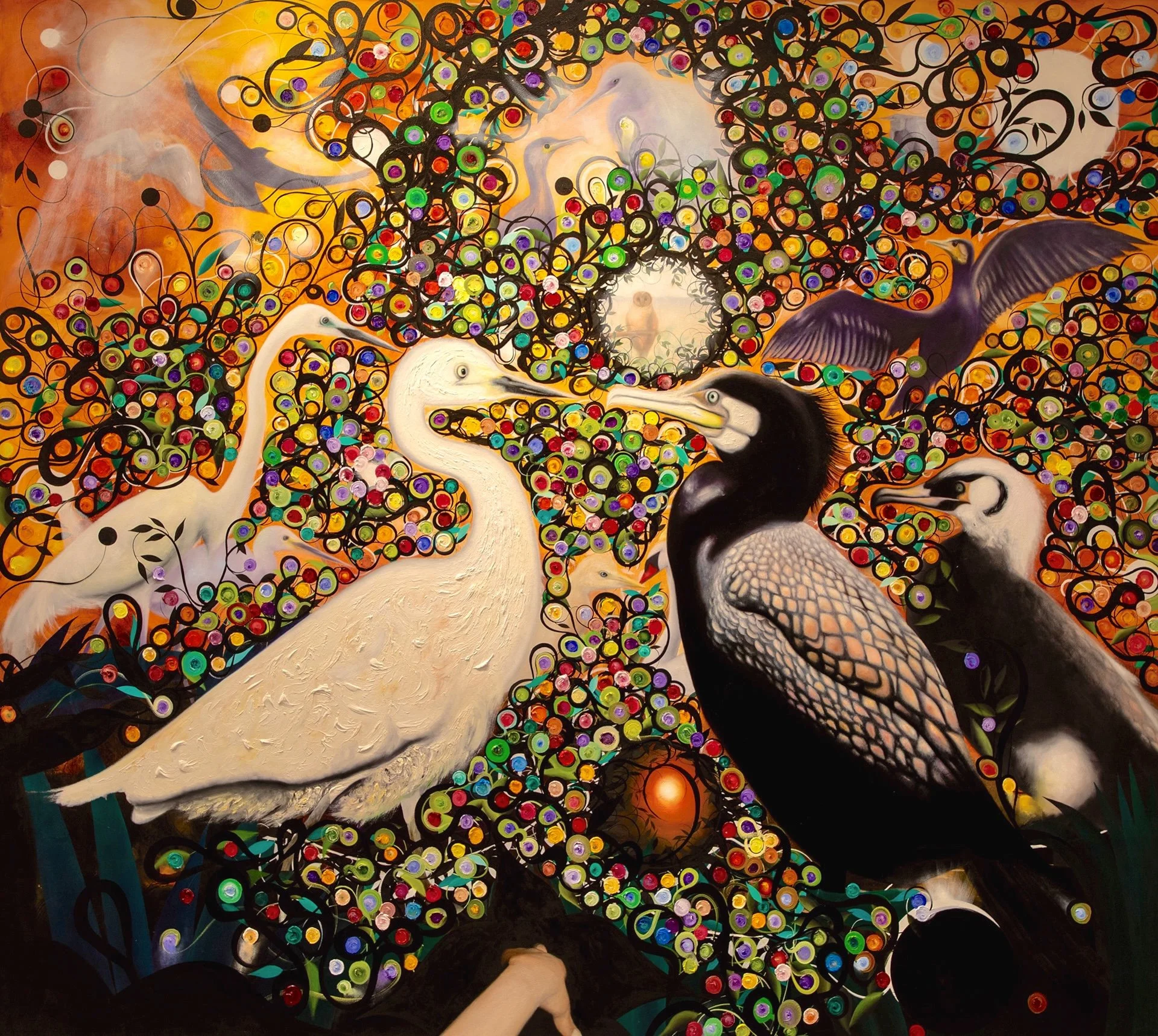
Kareem Moumina, Aliferous, Oil on canvas, New York, 2024
As the paintings developed, so did their complexity. For example, in paintings like Blooming Harmony, The Harmony of Birds and Aliferous, the birds appear out of dense fields of color and then vanish once more. Organic shapes exist alongside swirling, almost calligraphic markings. The various influences which had previously appeared separate started to be incorporated into the same visual style: Rousseau's flattened jungle scenes, Monet's sensitivity to color, the Renaissance traditions of observation, Modernist treatments of the picture plane, and patterns that echo the geometric visual elements of Islam. The more I painted, the less interested I became in fitting neatly into one tradition and I wished the work to express the complexity of the world as I had experienced it.
Yet the reason why I keep on painting has now become a great deal simpler: I paint out of love. My love for nature, for people, for memory, and for the odd privilege of being conscious enough to realize that the world exists at all. The act of painting makes me pay attention, and I have come to see that paying attention is in itself an act of love. When you look closely at something you are acknowledging its existence and, for a short time, give yourself entirely to it.
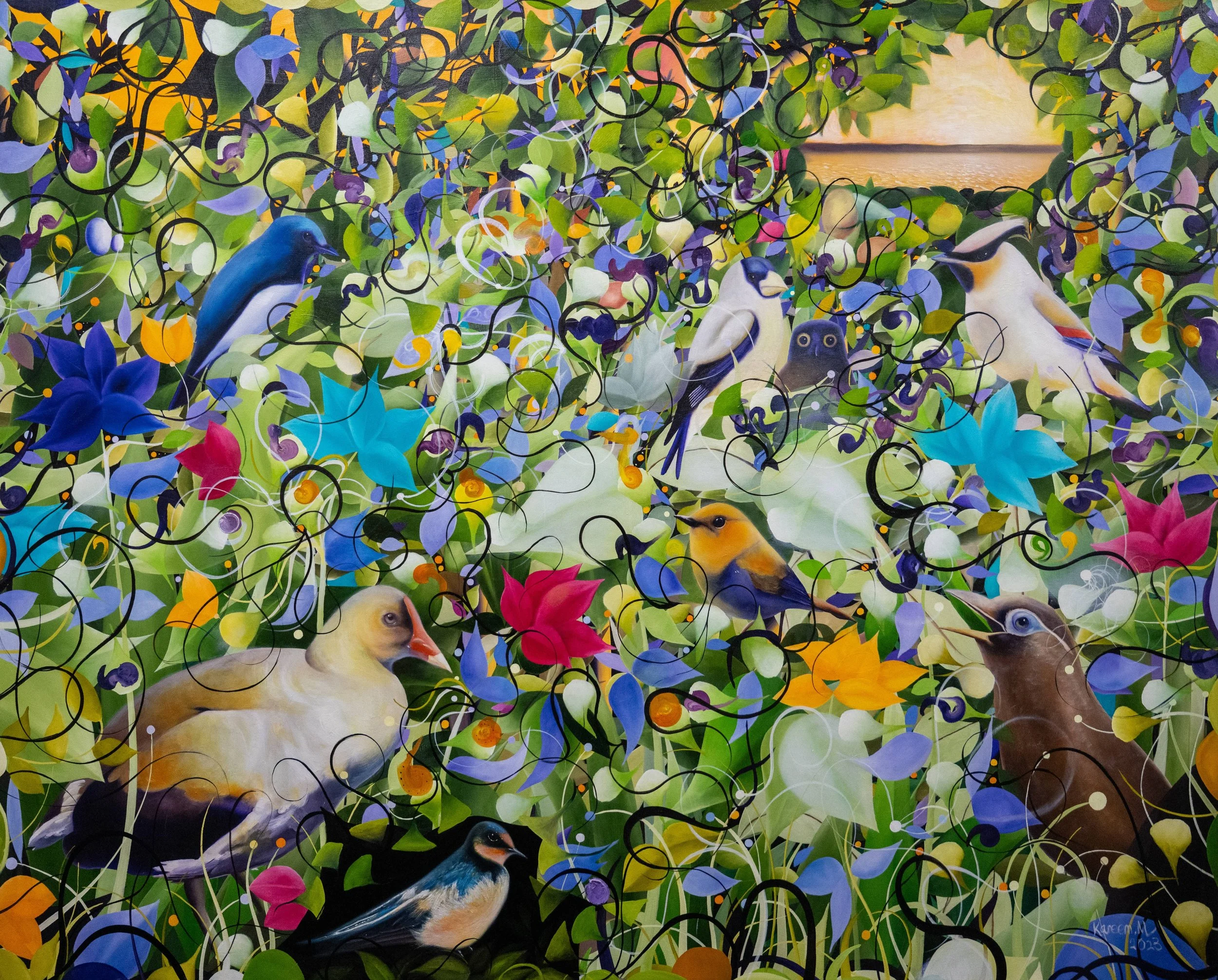
Kareem Moumina, Blooming Harmony, Oil on canvas, 48” x 60”, New York, 2023
At the beginning I painted landscapes in Jeddah, and I used to think that the way to become an artist was to learn how to paint well, but nowadays I don't consider that to be sufficient. I now see art as a means of discovering what is inside me while at the same time directing my attention to the outside world. Late in my thesis I expressed my understanding of artistic practice in terms of the idea of 'becoming': it is not merely a matter of acquiring skill or gaining recognition, but rather an continuous process of observation, experience and self-discovery. The works change because I change, and each painting contains something of the person I was when I produced it.
That is probably the reason why I keep going back to The Mandril. Nowadays, when I look at it, I don't merely see an early painting. I see my dorm room, the open window and the students pausing at the door, Rousseau, the start of my interest in nature, and most important of all a younger version of myself beginning to discover a world which he did not at that time realize would become his life. It is the painting that reminds me that becoming an artist was not the result of a single moment but rather a slow process involving learning to see more deeply, questioning what one sees, and staying open to wonder.
I am still in the process of becoming.